Webscale AI and Webeyez team up to catch shoppers before they leave
A new integration connects Webeyez's friction detection to the Webscale AI Shopping Assistant, so a failing search or a stalled browsing session gets a save instead of a bounce.
 Adrian LunaSVP of Growth, Webscale AI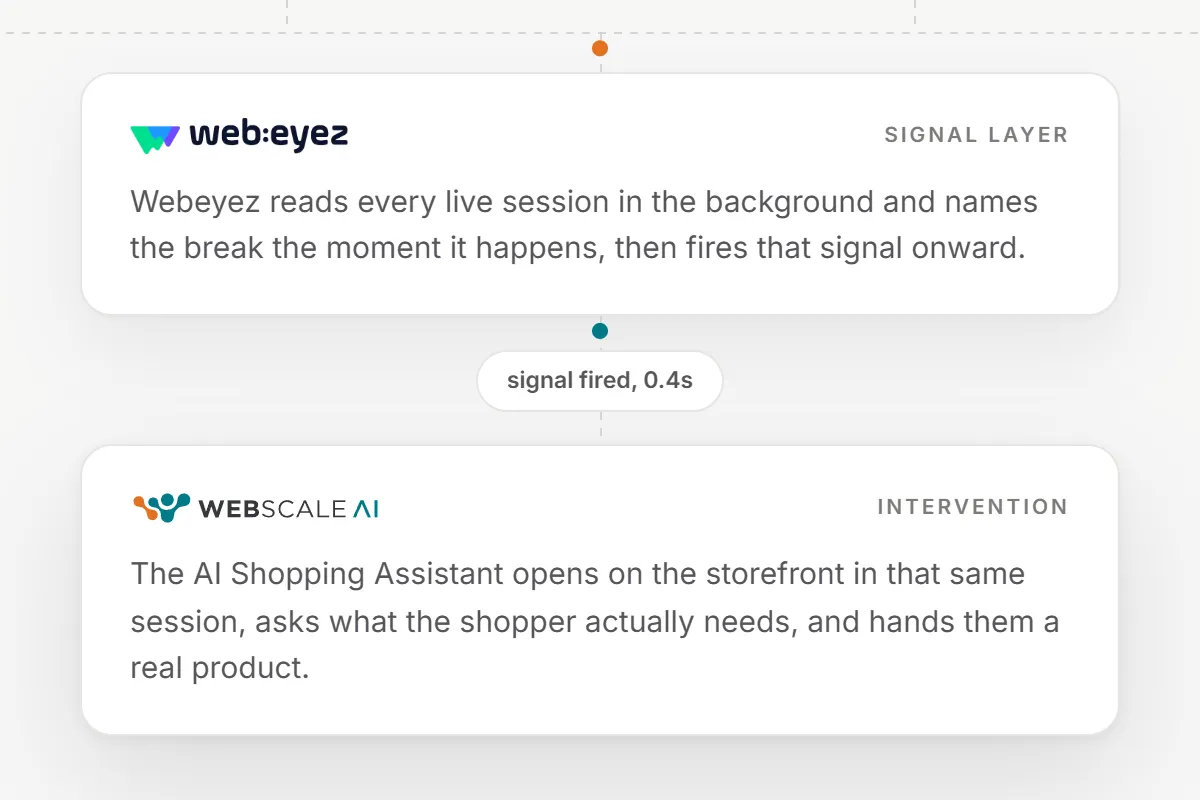
Webscale AI and Webeyez today announced a partnership that connects friction detection to real-time conversational recovery. Webeyez identifies the exact moment a shopper’s experience breaks down. The Webscale AI Shopping Assistant acts on it before the shopper leaves.
The integration is available today on Adobe Commerce and Magento, Shopware, Shopify, and WooCommerce.
What a failed search actually costs
Search abandonment costs retailers more than $234 billion a year in the US alone, and most of that traffic simply leaves rather than trying again. Most of that loss is invisible until it shows up in a quarterly report, long after the shopper is gone. This integration closes that gap in real time.
lost by US retailers to search abandonment every year, most of it invisible until the quarter closes.
Google Cloud and Harris Poll“Failed search is a bigger problem than most merchants realize. It contributes to bounce, and it costs you traffic you never got the chance to convert. That shopper either goes to a competitor or goes back to a search engine, and now you are competing for them all over again. What we look for is a signal that tells us the exact moment to bring the assistant in. Webeyez gives us that.”
Adrian Luna, SVP of Growth, Webscale
How it works
Three scenarios, live today.
Failed search
Webeyez flags a session where a shopper’s search returned nothing that matched their intent. The AI Shopping Assistant steps in, asks what the shopper is actually looking for, and surfaces a real product instead of a dead end.
Slow or unproductive browsing
Webeyez flags degraded performance or a shopper stuck paging through a catalog without success. The assistant offers a direct path to a fast, relevant product page.
Exit intent and idle time
Webeyez flags a shopper about to leave, or stuck on a page that tends to confuse: fitment, compatibility, anything that makes a shopper pause. The assistant steps in before the shopper has decided to go.
Triggers built to the storefront
Every storefront has its own friction points. During onboarding, Webscale and Webeyez build the exact triggers a merchant needs, not just the three above.
“For a decade, ecommerce analytics has been very good at telling merchants what went wrong and very bad at doing anything about it. Conversational AI changes that equation. Webeyez supplies the signal that a shopper is stuck, Webscale’s assistant acts on it in real time. Detection and resolution stop being two separate products. This is the kind of partnership where one plus one equals three, and we’re moving on it with real urgency ahead of the holiday season.”
Uri Strauss, Founder and CEO, Webeyez
Full integration details are on the Webeyez partner page.
Before you take this to your team
It connects Webeyez's friction detection to the Webscale AI Shopping Assistant, so signals like a failed search, a slow page, or exit intent trigger a real-time response from the assistant instead of the shopper leaving.
Adobe Commerce and Magento, Shopware, Shopify, and WooCommerce.
Yes. The integration connects an existing Webeyez deployment to an existing Webscale AI Shopping Assistant deployment on the same storefront.
Today. The integration is generally available on every supported platform, and merchants can book a demo or start a pilot now.
Catch the sale you were about to lose
See the full integration on the Webeyez partner page, or talk to Webscale AI about adding the Shopping Assistant to your storefront.