The failed search that could still become a sale
Webeyez detects when shoppers get stuck. The Lagrange AI Shopping Assistant uses that signal to help them find the right product while they’re still on your site.
 Renee GoldbergWebscale AI
 Uri StraussFounder and CEO, Webeyez
A shopper searches your store for a specific product. The results come back empty.
They try another search. Maybe they browse a category. Eventually, they leave.
Your analytics might record an unsuccessful search or a bounce. What they don’t tell you is whether that shopper could have been helped before leaving.
That’s the problem the Webscale AI and Webeyez integration is designed to address.
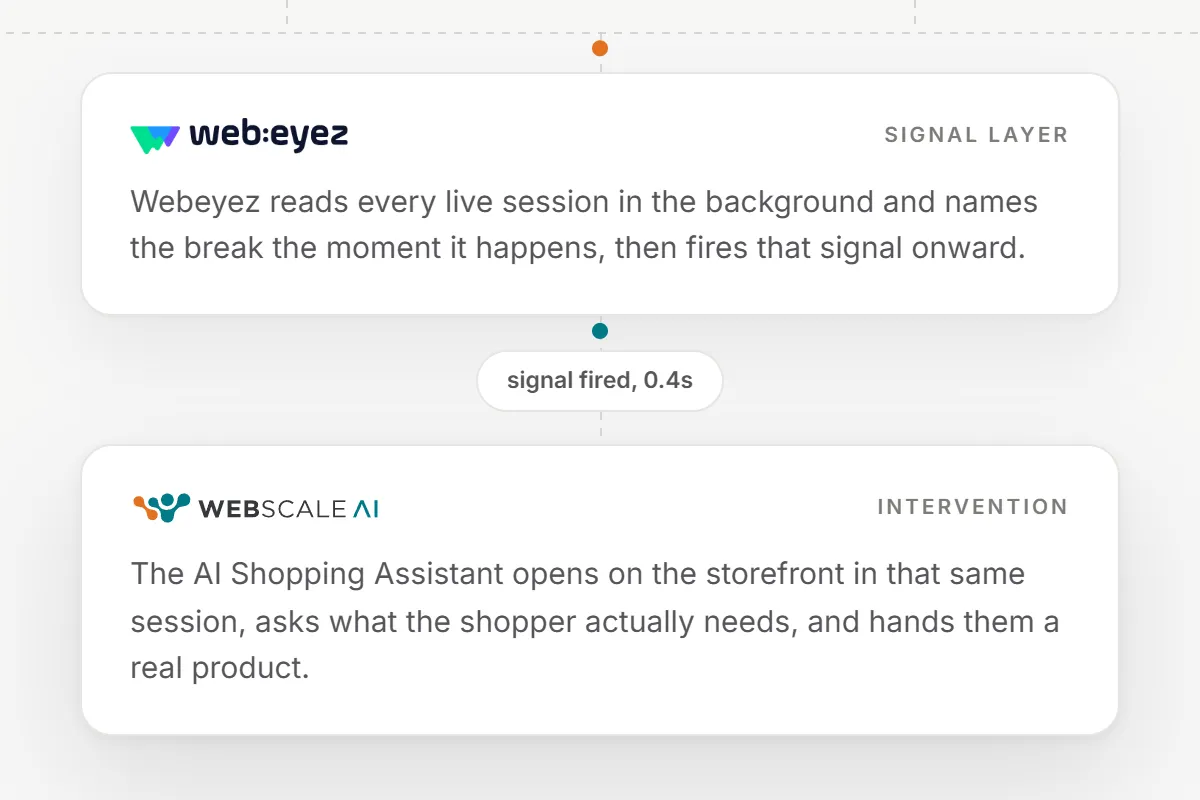
Webeyez detects friction as it happens. The Lagrange AI Shopping Assistant uses that signal to engage the shopper with relevant product guidance during the same session.
What a zero-result search costs
A zero-result search happens when a shopper enters a query and the site’s search engine returns no matching products.
Sometimes the product really isn’t available. Other times, the store has something that meets the shopper’s needs, but the search engine doesn’t understand the language they’re using.
Consider a shopper searching an automotive parts catalog for a replacement component. They know the vehicle and the problem they’re trying to solve, but they don’t know the manufacturer’s part number.
A keyword-based search may return nothing even when a compatible product exists.
That’s a shopper with purchase intent who needs help finding the right item.
A 2023 Google Cloud-commissioned Harris Poll study found that search abandonment costs US retailers more than $234 billion annually. The same research found that unsuccessful searches frequently drove shoppers to competing retailers.
Google Cloud and Harris Poll, 2023The opportunity is to recognize the problem while the shopper is still there.
How Webeyez and Webscale AI work together
The integration connects real-time shopper friction signals from Webeyez to the Lagrange AI Shopping Assistant.
Webeyez identifies situations where a shopper needs help. The assistant can then intervene with relevant product guidance.
Supported scenarios include:
Failed search
A shopper searches for a product and receives no useful results. Webeyez detects the unsuccessful search, allowing the assistant to step in and clarify what the shopper needs.
Failed payment
A shopper reaches checkout, but the payment is declined or fails due to a technical error. Webeyez detects the failure in real time, allowing the assistant to step in and reassure the shopper, guiding them toward completing the purchase, for example by suggesting another payment method.
Exit intent or stalled sessions
A shopper shows signs of leaving or gets stuck on a difficult product page. The assistant can offer help while the shopper is still engaged.
Failed login
A shopper tries to sign in but gets stuck on repeated failed attempts or an account error. Webeyez detects the failed login, allowing the assistant to step in and help the shopper recover access or continue as a guest, keeping their session moving toward purchase.
The key is the timing.
The assistant can use the triggering context to begin a more relevant conversation and recommend products grounded in the merchant’s catalog.
It gives the store another opportunity to help a shopper who might otherwise leave.
What happens when a failed search triggers the assistant?
Picture a shopper looking for a replacement part.
Their first search returns no results. Webeyez detects the event and triggers the Lagrange AI Shopping Assistant.
Instead of requiring the shopper to start another search from scratch, the assistant asks a clarifying question about the model or required compatibility.
Using the store’s product data, it can identify a relevant option and help the shopper continue toward a purchase.
Illustrative workflow, not a published customer result.
The integration is designed to connect the moment of friction with an opportunity to resolve it.
“Friction data is only valuable if you act on it in time. By the time a report shows a failed search, that shopper is gone. Connecting Webeyez to the Webscale AI Shopping Assistant means the store can respond while the shopper is still there.”
Uri Strauss, Founder and CEO, Webeyez
How do you know whether the intervention is working?
Detecting friction is useful. Merchants also need to understand whether intervening changes the shopper’s experience.
Start by measuring the searches that return no results and the sessions where shoppers abandon product discovery.
Then evaluate what happens when the assistant intervenes.
Useful measures include:
- Search recovery rate: the share of unsuccessful searches followed by meaningful product discovery
- Assistant engagement: how often shoppers interact after an intervention
- Conversion after intervention: whether sessions receiving assistance result in completed purchases
These metrics should be evaluated against an appropriate baseline or comparison group before attributing improvements to the integration.
The goal is to make friction visible and measure what happens when merchants act on it.



Before you take this to your team
A zero-result search occurs when an ecommerce search engine returns no matching products for a shopper’s query. It can indicate missing inventory, poor product data or a mismatch between shopper language and catalog terminology.
An AI shopping assistant can ask clarifying questions and use catalog data to recommend relevant products. When connected to friction detection, it can offer that help during the same shopping session.
Webeyez identifies shopper friction signals, including failed searches, failed payments, failed logins and stalled sessions. The Lagrange AI Shopping Assistant uses those signals to engage shoppers with relevant assistance.
The published integration supports Adobe Commerce and Magento, Shopware, Shopify and WooCommerce.
Not to use either one. Webeyez and the Lagrange AI Shopping Assistant each work as standalone products. To get the specific handoff described here, friction detected by Webeyez triggering the assistant in the same session, both need to be running on the same storefront.
Triggers can be configured per storefront. The available options depend on the implementation.
See how a failed search can become a conversation
Your store already has shoppers telling you what they need through their searches and browsing behavior. Webeyez helps identify where those shoppers are getting stuck. The Lagrange AI Shopping Assistant gives you a way to help them while they’re still engaged.